-
- Share:
-

-

-

-

Nonprofit tax returns are essential for maintaining your organization’s tax-exempt status and IRS compliance in meeting 990 deadlines. Although nonprofits are exempt from federal income taxes, they must report their financial activities annually to the IRS to ensure transparency. Filing requirements vary based on each nonprofit’s size, structure, and financial transactions. Whether submitting Form 990, 990-EZ, or 990-N e-Postcard, each has its specific deadlines and compliance obligations.
Missing these forms can lead to penalties, increased scrutiny, or even the loss of your tax-exempt status after repeated noncompliance. Hence, it is essential to know which form to file, when it’s due, and how to ensure your information is accurate and comprehensive. In this article, we’ll discuss everything you need to know about filing nonprofit tax returns and also demonstrate how tax2efile simplifies the process, enabling nonprofits to file quickly, accurately, and stress-free.
Table of Contents
Do Nonprofits Generally Need to File Tax Returns?
Yes, nonprofits are required to file their annual information returns with the IRS, although they don’t need to pay any taxes.
The Importance of Filing
- Regular filings help to maintain their business and ensure compliance with tax-exempt requirements.
- Financial transparency attracts donors and stakeholders to maintain credibility.
- Accurate filings reduce the risk of penalties and ensure compliance with all legal requirements on time.
- Accurate filings also help organizations review financial performance and make informed decisions.
Note: If you haven’t filed for three consecutive years, that results in automatic revocation of tax-exempt status. It can be costly and time-consuming to restore.
Knowing the Multiple IRS Forms for Nonprofits
Multiple IRS forms have created different requirements and forms for nonprofits based on the type of nonprofit, tax-exempt status, and annual gross receipts. The various IRS forms available for nonprofit exemption are listed below.
- Form 990: Organizations generally file Form 990 if they have gross receipts of $200,000 or more, total assets greater than $500,000, along with the organization’s mission, the names of board members, donors, and foundation names.
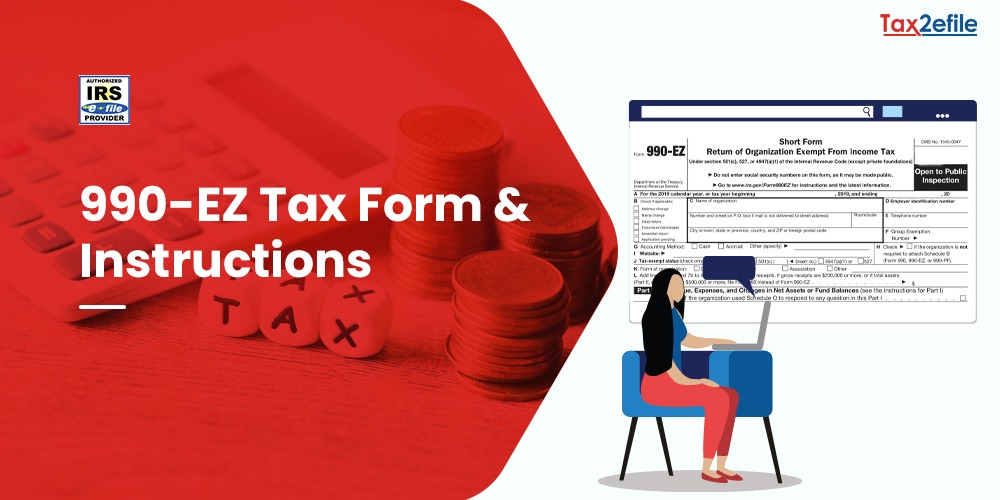
- Form 990-EZ: Organizations may file Form 990-EZ if gross receipts are less than $200,000 and total assets are less than $500,000.
- Form 990-PF: Private foundations generally must file Form 990-PF annually, regardless of revenue size.
- Form 990-N: This tax return is filed with gross receipts of small 501c nonprofits $50,000 or less, and this postcard is submitted online only.
Deadlines, Penalties, and Common Mistakes in Filing Nonprofit Tax Returns
Deadlines
The standard due date of nonprofit tax returns is the 15th day of the 5th month after the end of the fiscal year. For the extension file Form 8868 to apply for an automatic six-month extension.
If your fiscal year ends on December 31, your due date is May 15 of the following year.
Penalties
- Late fee for large organizations can be $130 per day with gross receipts over $1,000,000
- Late fees for small organizations can be $25per day with gross receipts less than or equal to $1,000,000.
Common Filing Mistakes
The common mistakes include choosing the wrong form, incomplete governance disclosures, inaccurate expense reporting, missing deadlines, and providing outdated information.
Step-by-Step Process to File Nonprofit Tax Returns
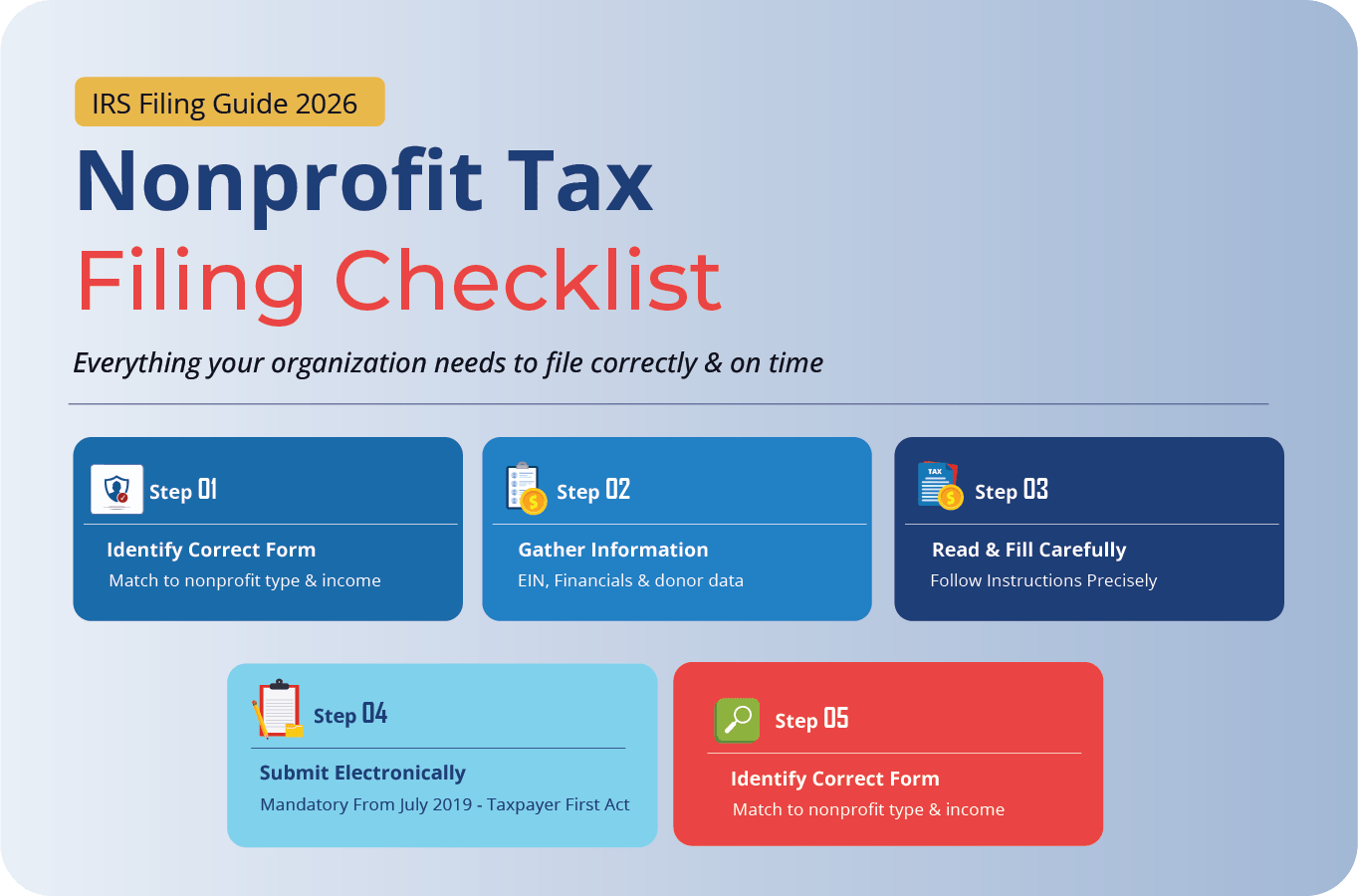
- Identify the correct form for each nonprofit type and income amount. If needed, get assistance from an authorized e-filing platform like Tax2efile.
- Gather the required information like organizational details (EIN, legal name, and address), financial records, revenue sources, detailed records of expenses (receipts, management, and fundraising costs), and donor information.
- Read the instructions carefully and fill in the details correctly.
- Make sure to submit the forms electronically as of July 2019, and the passage of the Taxpayer First Act.
- Double-check all entries to avoid errors or IRS penalties.
Nonprofit tax filing returns show your organization’s responsibility, transparency, and commitment to its goals in filing an annual requirement. Nonprofits can avoid penalties and build trust with stakeholders and donors by maintaining accurate records in compliance with IRS filing requirements. An efficient filing strategy not only ensures compliance but also provides a solid operational foundation for your company to focus on what matters most and make an impact. With Tax2efile, you can file with confidence, reduce administrative burden, accelerate the nonprofit filing process, and file error-free by the deadline.
 FAQs
FAQs
What is a nonprofit tax filing?
Nonprofit tax filing refers to the mandatory annual reporting that tax-exempt organizations must submit to the IRS to maintain their legal status, even if they owe no income tax. These filings provide transparency and build trust with the organization’s finances, mission, and governance.
How to extend the due date for filing tax returns?
Nonprofits can file Form 8868 for an automatic six-month extension on their tax returns. On certain business income tax returns, organizations must file Form 7004 for an automatic extension.
How long should nonprofits keep records?
Nonprofits should adopt a formal document retention policy and keep their records for at least seven years, and permanently maintain certain documents like incorporation, bylaws, and board minutes.
Can a nonprofit lose its tax-exempt status?
Yes, failure to file for three consecutive years results in automatic revocation.
What happens when the submitted Form 990 is incomplete or wrong?
If your Form 990 is provided with wrong information or incorrect, then the IRS will send it back with letters like 2694C Returning Form 990 due to missing information, 2695C Returning Form 990-EZ due to missing information, and 2696C Missing Information Request to Process EO Return.