- September 9, 2026
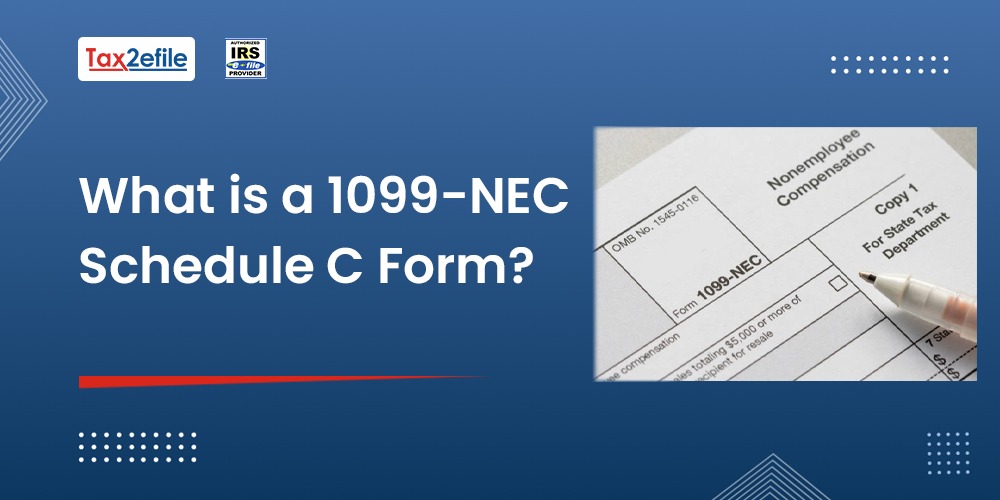
If you received Form 1099-NEC for freelance, contract, gig, or other self-employed work, the income is generally reported on Schedule C (Form 1040) when you operate the activity as a sole proprietor or a single-member LLC treated as a disregarded entity.
The forms do different jobs. Form 1099-NEC tells you and the IRS how much a payer reported as nonemployee compensation. Schedule C reports your business income and deductible expenses and calculates the business’s net profit or loss.
For 2026, there is an important change: businesses generally must issue Form 1099-NEC when qualifying nonemployee payments reach $2,000, up from the previous $600 threshold. The $2,000 amount is a payer reporting threshold, not a tax-free amount for contractors. Business income generally must still be reported even when no 1099-NEC is issued.
Table of Contents
What is Schedule C?
Schedule C, Profit or Loss From Business, is filed with Form 1040 by sole proprietors and certain other individuals operating a trade or business. It reports gross business receipts, allowable business expenses, and the resulting net profit or loss.
Independent contractors commonly use Schedule C because they work for themselves rather than as employees. A single-member LLC disregarded for federal income tax purposes generally reports its business activity on the owner’s Schedule C.
A partnership, S corporation, or C corporation generally does not report its business income on Schedule C simply because it received a Form 1099-NEC.
Where Do You Report 1099-NEC Income on Schedule C?
For a typical self-employed taxpayer, business income reported on Form 1099-NEC is included with gross receipts on Schedule C, Line 1.
Line 1 should not include only the amounts shown on 1099 forms. It should reflect gross receipts from the business, including business income for which no Form 1099 was issued.
If you received several 1099-NEC forms for the same business activity, their amounts are generally combined with the rest of that business’s receipts on one Schedule C. If you operate separate, unrelated businesses, you may need a separate Schedule C for each business.
The IRS also instructs taxpayers to make sure amounts properly reported on Forms 1099-NEC are included in Schedule C gross receipts. If the total reported on the 1099-NEC forms is greater than the amount reported on Schedule C Line 1, an explanation may be required.
Example: How 1099-NEC and Schedule C Work Together
Maria is a freelance graphic designer. During 2026, she receives $18,000 from Client A and $7,000 from Client B, both reported on Forms 1099-NEC. She also earns $4,000 from smaller projects that are paid directly to her and are not reported on a 1099.
Maria’s Schedule C gross receipts are $29,000—not $25,000.
Assume she also has $6,500 of allowable business expenses for software, advertising, supplies, and other ordinary and necessary costs. Before other possible adjustments, her simplified business profit would be $22,500.
This is the key distinction: a 1099-NEC reports what a particular payer reported to the IRS. Schedule C reports the business’s financial activity.
What If You Earn Less Than $2,000 and Do Not Receive a 1099-NEC?
You may still have taxable income.
Suppose a consultant receives $1,500 from a business during 2026 and no Form 1099-NEC is issued because the payment is below the general $2,000 reporting threshold. If that $1,500 was earned from the consultant’s business, it generally still belongs in business income.
The reporting threshold determines when the payer generally has to issue the information return. It does not determine whether the recipient can ignore income below that amount.
Can You Deduct Business Expenses Against 1099-NEC Income?
When the income comes from a trade or business reported on Schedule C, ordinary and necessary business expenses may generally be deductible if they meet federal tax rules.
Depending on the business, expenses may include advertising, supplies, software, professional fees, qualifying vehicle costs, business insurance, office expenses, and certain home-office expenses. Keep records that show the amount, date, and business purpose of each expense.
Schedule C calculates net profit or loss after allowable expenses. That net amount, rather than the gross amount on a 1099-NEC, is generally relevant when calculating self-employment tax.
Do You Also Need Schedule SE?
Often, yes. The IRS generally requires Schedule SE when net earnings from self-employment are $400 or more. Schedule SE calculates Social Security and Medicare taxes on self-employment income.
Because independent contractors typically do not have an employer withholding income tax, Social Security tax, and Medicare tax from each payment, they may also need to make estimated tax payments during the year.
Does Every 1099-NEC Go on Schedule C?
No. Schedule C is common, but not automatic.
If the payment came from a regular, profit-seeking trade or business you operate as a sole proprietor, Schedule C is generally the right place. If the activity was not carried on as a business for profit, different reporting may apply. Partnerships and corporations generally use their own business returns.
This is why the phrase “1099 contractor” is not enough to determine tax treatment. The correct form depends on what the payment was for and how the activity is structured for federal tax purposes.
Common 1099-NEC Schedule C Mistakes
Common errors include reporting only income shown on 1099 forms, treating the $2,000 payer threshold as a tax-free exclusion, creating a separate Schedule C for every client instead of each distinct business, overlooking supportable business expenses, and forgetting Schedule SE when required.
Also compare each 1099-NEC with your own records. If the payer reported an incorrect amount or taxpayer identification number, contact the payer promptly about a correction.
Frequently Asked Questions
Is 1099-NEC Income Reported on Schedule C?
Usually, yes, when the payment is compensation from a sole proprietorship or other self-employed trade or business. The amount is generally included with the business’s gross receipts.
What Line Does 1099-NEC Income Go on Schedule C?
For typical self-employment business income, amounts properly reported on Form 1099-NEC are included in Schedule C, Line 1, Gross receipts or sales.
Do I Need Schedule C If I Received Only One 1099-NEC?
Possibly. The number of 1099 forms does not determine whether Schedule C is required. What matters is whether the income came from a trade or business that you operated as a Schedule C filer.
Do I Report 1099-NEC Income Before or After Expenses?
Gross business receipts are reported as income on Schedule C. Eligible business expenses are then deducted in the appropriate categories to determine net profit or loss.
Do I Report Freelance Income If I Did Not Receive a 1099-NEC?
Generally, yes. Taxable business income does not become nonreportable simply because no information return was issued.